
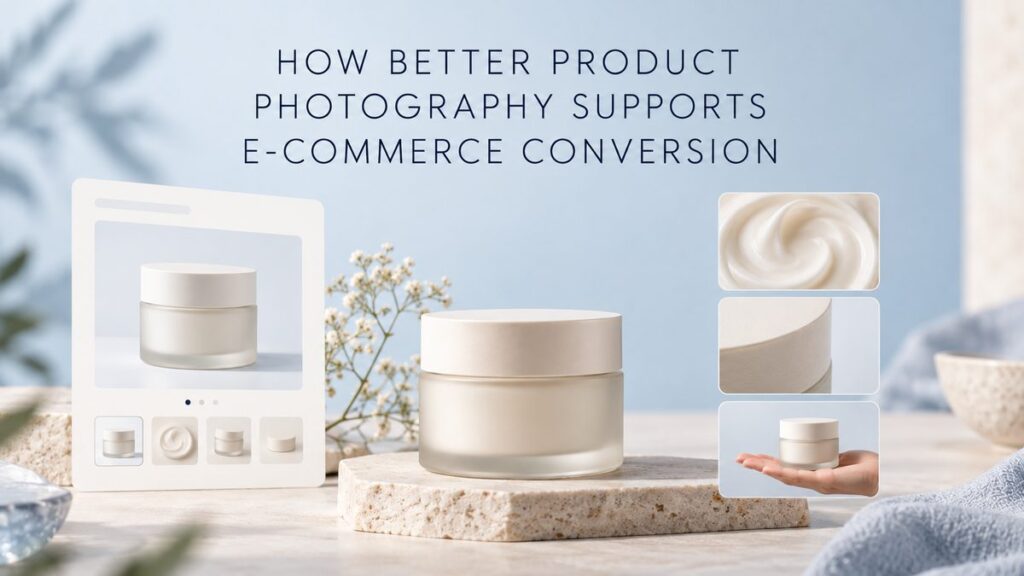
Better product photography supports e-commerce conversion by helping shoppers answer practical questions before they buy. Clear images show what the product looks like, what is included, how large it is, how it works, how the texture behaves, and how one option differs from another. Photography cannot guarantee a sale, but it can reduce uncertainty and make a product page easier to evaluate.
The goal is not to add as many images as possible. It is to build a purposeful sequence that gives the right information in the order shoppers need it.
How Does Product Photography Influence an Online Purchase?
In a physical store, a shopper can pick up a package, turn it around, compare sizes, inspect the finish, and imagine using it. An e-commerce page has to replace those interactions with photographs, video, copy, specifications, and interface design. Product photography contributes by making visual information immediate and believable.
For beauty, skincare, cosmetics, wellness, and lifestyle products, this may include the front label, side and back packaging, closure, applicator, formula texture, shade, scale, and routine context. Each frame should resolve a specific question rather than repeat the same angle with minor styling changes.
Which Product Images Reduce Uncertainty?
A clear primary image
The main image should make the product instantly recognizable. It needs a clean silhouette, accurate color, readable packaging where practical, and a crop that works at thumbnail size. Marketplace rules may determine the background and framing.
Multiple useful angles
Front, side, back, top, and three-quarter views are valuable when they reveal different information. A jar may need a lid and open-product view; a pump bottle may need a close view of the dispenser; a boxed set may need its contents arranged clearly.
Detail photographs
Close views can show material finish, label texture, stitching, hardware, applicators, seals, or small design features. A product detail shot should clarify something the wider view cannot.
Scale and in-use context
Dimensions in copy are useful, but a hand, shelf, bag, or familiar object can make size easier to understand. Context also shows how the product fits into a routine. It must remain truthful and should not create unapproved performance or usage claims.
Texture and color views
Beauty shoppers may need to see whether a formula is translucent, glossy, dense, whipped, fluid, or pigmented. Texture photography should use the real product whenever possible and preserve its color and consistency. Shade images need controlled light and a reliable color workflow.
Does Image Quality Automatically Increase Conversion?
No. High production quality is useful only when the images remain informative. A dramatic campaign photograph may attract attention but fail to show the label or package shape. A technically perfect pack shot may still leave questions about scale or use. Strong e-commerce content combines accuracy, consistency, and brand expression.
Conversion also depends on product-market fit, pricing, page speed, copy, reviews, shipping, returns, trust, and checkout. Photography supports the decision; it should not be presented as a guaranteed result.
Why Does Consistency Matter Across a Product Catalog?
Consistent framing, scale, background, shadow, color, and retouching make products easier to compare. A collection page feels more organized when bottles sit on the same baseline and occupy a similar proportion of each frame. Variation is appropriate when package dimensions differ, but it should follow a documented rule.
Consistency also helps a brand reuse imagery across product pages, collection grids, email, retail presentations, and advertising. A production guide can record camera angle, crop, lighting direction, background value, shadow treatment, and export sizes for future launches.
How Many Images Should a Product Page Have?
There is no universal number. Use enough images to answer the product-specific questions without repeating information. A simple boxed item may need fewer views than a skincare set with multiple components, textures, and steps. Start with the risks of misunderstanding, then assign an image to each.
Our guide to how many images a product page should have offers a planning framework based on complexity and channel. The e-commerce photo checklist translates that framework into a production list.
What Order Should Product Images Follow?
A practical sequence moves from identification to evaluation and then context:
- Primary product view
- Alternative angle or package view
- Important feature or detail
- Scale, open, or in-use view
- Texture, shade, or applicator
- What is included or routine grouping
- Styled or lifestyle image
This order is not mandatory. A distinctive launch may place a hero image earlier, while a technical product may prioritize diagrams or detail views. Test the sequence on mobile, where shoppers see one frame at a time.
How Do Hero Images and Product-Page Images Work Together?
A hero shot creates recognition and emotional direction. It may use a styled background, props, dramatic light, or an unusual composition. Product-page images provide the evidence: clear views, texture, scale, packaging, and use.
Both can be produced within one visual system. Matching color, lighting character, and retouching helps the campaign image lead naturally into the product information instead of feeling like a separate brand.
Why Do Crops and File Preparation Matter?
An image can be beautiful and still be ineffective if the product becomes tiny on mobile, the label is cut off, or the file loads slowly. Plan square, vertical, and horizontal uses before the shoot. Capture enough resolution and composition flexibility for intended crops, then export appropriately for each destination.
Compression should reduce file weight while preserving label edges, gradients, and texture. Use descriptive filenames and accurate alt text for accessibility and image search. Alt text should describe content and function instead of repeating keywords.
How Can Brands Evaluate New Photography?
Define the page problem before replacing images. Are shoppers unable to judge size? Are variants difficult to compare? Is the texture unclear? Are mobile crops inconsistent? A specific hypothesis makes later evaluation more meaningful.
Brands can compare page behavior, support questions, returns feedback, and conversion data before and after a controlled change. Avoid changing photography, price, layout, copy, and promotion at the same time if the goal is to understand what affected the result. Smaller businesses can collect recurring customer questions and use them to improve the next shot list.
What Belongs in an E-Commerce Photography Brief?
- Products, variants, and packaging versions
- Required image types and the question each answers
- Destination platforms and image specifications
- Crop orientations and safe areas
- Approved colors, claims, and usage instructions
- Reference images describing direction rather than inviting copies
- Priority images for launch and secondary assets
- File naming, delivery, and revision process
Professional e-commerce photography can combine repeatable catalog standards with selected styled images. When motion explains an action, texture, or transformation more clearly, product videography can complement the still-image sequence.
Frequently Asked Questions
Do lifestyle photos replace white-background images?
Usually not. Lifestyle images add context, while clean product views support comparison and accurate evaluation. Most useful libraries include both when the channel allows it.
Should every variant have its own photographs?
Photograph variations whenever color, finish, size, packaging, or included components differ in a way that affects the decision.
Can supplier images be mixed with new photography?
They can, but differences in lighting, crop, color, and retouching may make the catalog feel inconsistent. Establish shared standards before combining sources.
Are infographics product photography?
Infographics are designed assets that may incorporate photographs. They can explain features, dimensions, or steps, but should not replace clear source images.
Build Images Around Real Shopper Questions
Better e-commerce photography begins with the information a shopper cannot inspect in person. If you need a practical image plan for a beauty, skincare, cosmetics, wellness, or lifestyle product, contact Picture Your Products to discuss the product and its sales channels.