
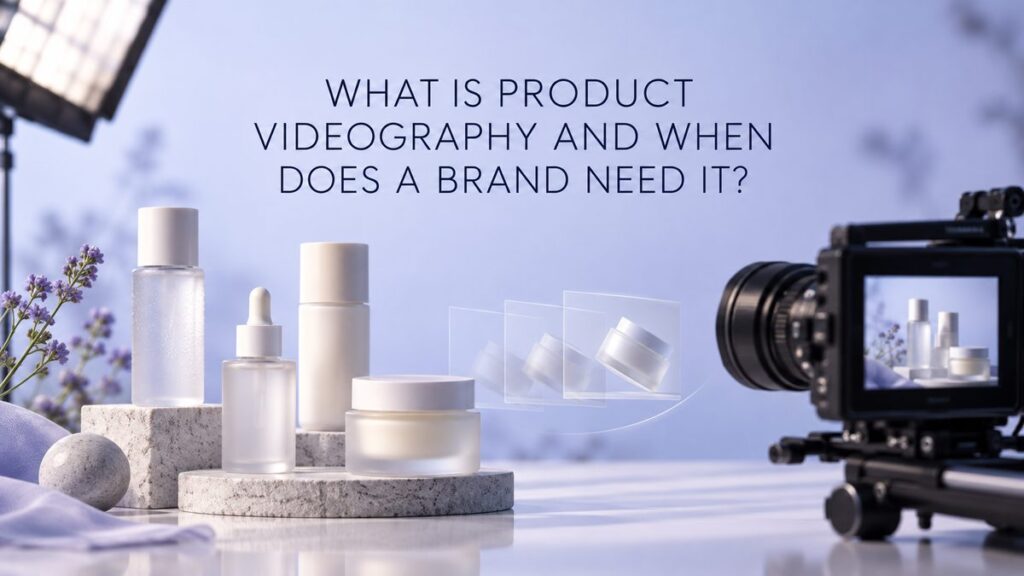
Product videography is the planned filming and editing of a product to show its appearance, features, texture, movement, use, or brand story. A brand needs product video when motion explains something that still photography cannot show as clearly, or when a sales channel, launch, advertisement, or social placement requires moving content.
Video should solve a communication problem, not exist only because competitors use it. For beauty, skincare, cosmetics, wellness, and lifestyle products, that problem may be demonstrating a pump, revealing a formula texture, showing an application sequence, rotating reflective packaging, or presenting a collection with movement.
What Does Product Videography Include?
Product videography can range from a simple rotating pack shot to a fully styled campaign sequence. Production may include tabletop filming, macro details, hand interaction, texture movement, stop motion, camera movement, lighting changes, or edited combinations of several shots.
The deliverables depend on the goal. A product-page clip, vertical social edit, paid advertisement, launch teaser, and retailer asset have different lengths, crops, pacing, text areas, and sound requirements. These should be defined before filming so one setup can create useful variations without compromising the main piece.
What Can Video Explain Better Than Photography?
Movement and mechanism
Video can show a cap opening, pump dispensing, applicator moving, lid locking, zipper closing, or device operating. This is valuable when the action itself is part of the product experience.
Texture and consistency
A still image can show a cream or serum at one moment. Video can reveal flow, viscosity, spread, shimmer, foam, or how a formula reacts to light. The real product and approved usage should guide the demonstration.
Sequence and routine
Products used in steps can be presented in order. A concise routine video may clarify what comes first and how components work together. Usage instructions and claims should come from approved brand information.
Changing reflections and dimensional form
Movement helps viewers understand curved glass, metallic caps, embossed packaging, translucent formulas, and layered materials. Controlled lighting remains essential because reflective packaging can reveal the camera, crew, and studio.
Atmosphere and pace
Editing, motion, light, color, and sound can create a brand feeling that a single frame cannot. Creative direction should still leave the product identifiable and avoid sacrificing useful detail for effects.
When Does an E-Commerce Brand Need Product Video?
A brand should consider video when customers frequently ask how the product works, how large it is, how it opens, what the texture is like, or how it fits into a routine. Video can also support a launch that needs adaptable motion assets across a product page, email, advertising, and social media.
Video is less urgent when the product is visually simple, the important information is already clear in still images and copy, or the channel cannot display motion effectively. A complete e-commerce photo checklist may be the better first investment if essential front, back, detail, scale, and packaging views are missing.
What Types of Product Videos Are Most Useful?
- Product overview: a concise sequence showing the package, key angles, and important details.
- Demonstration: the product opening, dispensing, assembling, or operating.
- Texture video: formula movement, spread, droplets, swatches, foam, or powder.
- In-use video: hand or talent interaction that explains scale or application.
- Styled campaign film: a concept-led sequence for a launch or brand message.
- Stop motion: frame-by-frame movement suited to graphic, playful, or precise ideas.
- Loop: a short seamless action for a page, banner, or social placement.
The best format follows the communication need. A demonstration should be direct. A launch teaser can be atmospheric. A product page may need muted playback and clear action without relying on sound.
How Is Product Videography Different From Product Photography?
Photography freezes one selected moment and often provides greater resolution for detailed inspection, flexible crops, and catalog consistency. Video shows change over time and adds pacing, sequence, and sound. Both require product preparation, lighting, composition, color control, styling, and finishing.
The formats often work best together. A production can capture e-commerce photography, styled stills, and motion within a related visual direction. Switching between photo and video is not always instant: lighting, shutter requirements, camera movement, aspect ratio, and set durability may change. Plan the priority deliverables first.
What Should a Product Video Brief Include?
- The primary audience and business goal
- The exact question or story the video must communicate
- Products, variants, packaging, and approved claims
- Required shots, actions, and product behaviors
- Destination platforms and technical specifications
- Horizontal, square, and vertical versions
- Maximum lengths and safe areas for interface overlays
- Whether the video must work without sound
- Text, logo, music, voice, captions, and licensing requirements
- Reference material and brand guidelines
- Reviewers, deadlines, and delivery formats
A storyboard or shot map does not need to be elaborate. Simple frames can show the planned order, action, camera view, and transition. The goal is to identify missing coverage before the product is on set.
Does Product Video Need Sound?
Not always. Many placements begin muted, so essential information should remain understandable visually. Captions or on-screen text can support accessibility and comprehension when speech is used. Music and sound effects can shape pace and mood, but licensing must match intended platforms, territories, and duration of use.
Do not add audio simply to fill silence. A quiet product loop, subtle practical sound, or deliberately silent demonstration may be appropriate depending on the channel.
How Long Should a Product Video Be?
The video should be long enough to communicate the intended information and no longer. A loop may need only one clear action. A product overview may need several shots. A tutorial requires enough time for viewers to follow the steps. Platform limits matter, but the creative decision should begin with the viewer’s question.
Instead of forcing one edit everywhere, plan a master sequence and channel-specific versions. Capture handles before and after each action so editors have room to create different pacing and crops.
What Makes Product Video Look Professional?
Professional product video depends on preparation and control:
- Clean, current packaging with duplicates when possible
- Lighting that preserves shape, label legibility, and material finish
- Stable, intentional camera movement
- Actions rehearsed for repeatability
- Consistent exposure, focus, white balance, and color
- Sets and textures that remain usable through multiple takes
- Editing that supports the product instead of hiding it
- Exports prepared for each destination
Reflective bottles, transparent containers, liquids, powders, and formula textures may require testing. A motion setup exposes changing reflections and focus in ways a still frame does not.
How Should Products Be Prepared for Video?
Use final or approved packaging whenever possible, and check every label, cap, pump, seal, and surface. Bring duplicates because repeated handling, splashes, texture work, or condensation can change the package. Clean between takes and document the preferred fill level, product orientation, and label position.
Test actions before the final setup. A pump may dispense unevenly, a cream may change under warm lights, or a lightweight bottle may shift during camera movement. Rehearsal helps determine the lens, focus range, frame rate, and amount of product needed.
Can a Small Brand Start With One Product Video?
Yes. Choose one product or collection with a clear motion story and one primary destination. Build a focused shot list, then capture a few adaptable details and alternate crops when they are genuinely useful. Starting with a defined problem produces a more useful asset than attempting a large campaign without priorities.
If the immediate need is accurate catalog coverage, begin with studio product photography. If motion will explain application, mechanism, texture, or sequence, explore product videography services.
How Can Video and Still Images Share a Visual System?
Use the same approved palette, surfaces, prop logic, lighting character, and finishing standards. Still images may need a different camera position or more precise focus, while video needs room for movement and time. A coordinated brief can preserve recognition without forcing both formats into identical frames.
Plan a hero moment that can be captured as a still and as motion when practical. Also identify shots that are format-specific. A slow serum pour may be meaningful only in video; a detailed label view may work better as a high-resolution photograph.
Frequently Asked Questions
Is product videography the same as a commercial?
No. A commercial is one possible use. Product video can also be a demonstration, product-page loop, social asset, tutorial detail, or launch visual.
Can product video be created from still photos?
Still images can be animated or edited into a motion graphic, but they cannot show real product movement that was never captured. Label the approach accurately in planning.
Does every product need a video?
No. Prioritize products where motion resolves an important question or supports a defined channel and campaign need.
Can one shoot create vertical and horizontal video?
Often, but only when framing, set size, movement, and safe areas are planned for both. Some concepts need separate compositions.
Use Motion When Motion Adds Information
Product videography is most useful when it makes the product easier to understand or gives a campaign a purposeful moving identity. To plan video or coordinated still-and-motion assets for your brand, contact Picture Your Products.