
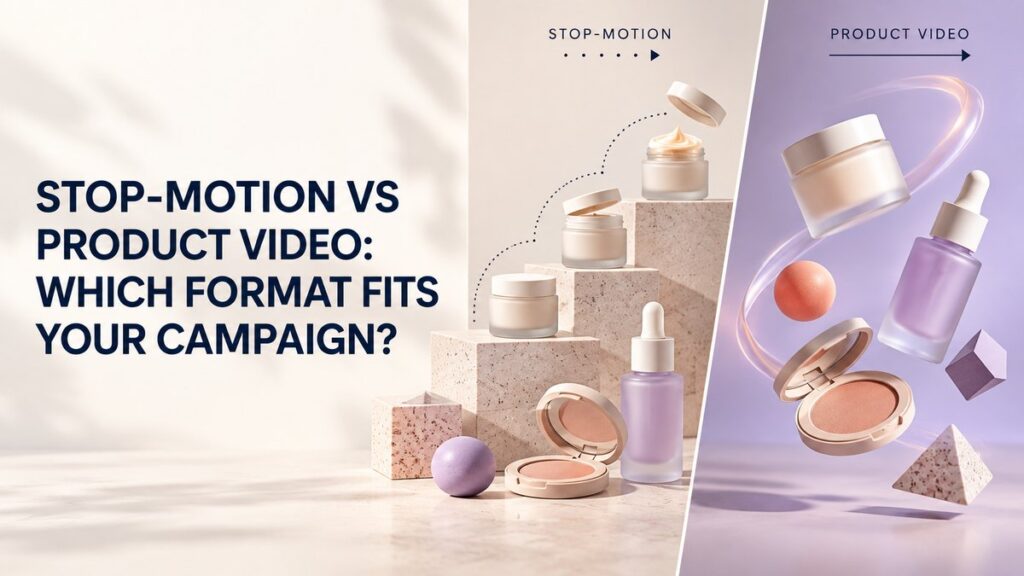
Choose stop-motion when the campaign needs precise, graphic, frame-by-frame movement that would be difficult or unnecessary to film continuously. Choose live-action product video when real-time motion, texture, application, hand interaction, or camera movement helps viewers understand the product. Neither format is universally better; the right choice follows the message, product behavior, channel, and production plan.
Beauty, skincare, cosmetics, wellness, and lifestyle brands can use both formats within one campaign. A stop-motion sequence may create a playful launch moment, while a live-action clip shows the serum dispensing accurately. The formats work best when each has a specific job.
What Is the Difference Between Stop-Motion and Product Video?
Stop-motion is created from individual photographs captured after small controlled changes. Live-action product video records continuous movement over time. Stop-motion builds motion one frame at a time. Product video records an action, camera move, or change as it happens.
This difference affects the look, preparation, set, timing, and type of action each format can show. Stop-motion can make an object appear to move by itself, transform between arranged positions, or follow a perfectly designed path. Live action preserves natural flow, momentum, texture behavior, and human timing.
When Is Stop-Motion the Better Choice?
When the idea is graphic or impossible in real time
Products can enter one by one, ingredients can form a pattern, lids can jump into place, or a collection can rearrange itself without hands. The frame-by-frame process gives precise control over position and rhythm.
When repetition supports the concept
Stop-motion works well with product families, shade ranges, kits, and repeated shapes. A sequence can introduce each variant, build a grid, or transform one arrangement into another. Consistent packaging, camera position, and lighting make the effect clean.
When a short loop is the main deliverable
A simple action that returns to its starting point can create a useful website or social loop. The concept should remain recognizable within a few seconds and should not rely on viewers understanding a complicated narrative.
When the brand voice is playful or highly designed
Stop-motion has an intentionally constructed quality. It can feel lively, precise, surreal, or tactile. That character suits some campaigns, but it should not be applied automatically to every product. A clinical or quiet luxury brand may prefer restrained movement, while a colorful cosmetics launch may support more energetic timing.
When Is Live-Action Product Video the Better Choice?
When the product behavior matters
Continuous video is usually clearer for a serum drop, cream spread, foam expansion, oil flow, powder dispersal, spray pattern, or closure mechanism. Real timing helps viewers judge texture and use.
When hands or talent demonstrate use
Hand interaction can show scale, grip, dispensing, opening, or a routine step. The motion needs rehearsal and accurate product handling. If application appears, it should follow approved instructions and avoid implying benefits the footage does not demonstrate.
When smooth camera movement adds dimension
A controlled push, orbit, slide, or focus change can reveal shape and materials. This is especially useful for reflective or translucent packaging, although the lighting must remain attractive through the full move rather than at one frozen angle.
When natural timing supports trust
Live action can feel direct because viewers see the product responding in real time. That quality is valuable for demonstrations, tutorials, and product-page clips where clarity matters more than visual novelty.
Which Format Better Shows Skincare Texture?
Live-action video usually communicates viscosity and application more accurately because it shows how the formula moves continuously. Stop-motion can present texture creatively—a series of droplets, a changing smear, or a product trail—but it may not explain natural flow.
Use the real formula whenever texture influences the buying decision. Record an approved reference and check color, consistency, amount, and speed. Pairing motion with clear skincare texture photography gives the product page both an inspectable still and a behavioral view.
Which Format Is Better for E-Commerce?
Live action is often the stronger choice when a product page needs demonstration, scale, or texture. Stop-motion can work when a short sequence highlights included items, variants, packaging, or a simple feature without sacrificing clarity.
The format should support the shopping task. A visually striking stop-motion clip that hides the label or makes size ambiguous may be better suited to a campaign placement than the main product page. Review which product videos help e-commerce shoppers decide to match video types to buyer questions.
How Do Production Requirements Differ?
Stop-motion production
The camera, lighting, and set must remain stable while the product is moved in small increments. The team plans the path, number of positions, frame order, and any replacement elements. Dust, labels, liquid levels, and prop positions require close control because small inconsistencies become visible during playback.
Textures and perishable elements can change between frames. A cream peak may settle, condensation may grow, or a botanical prop may shift. Testing identifies which elements can hold their shape long enough for the sequence.
Live-action production
Live action needs repeatable performance, appropriate shutter and frame-rate choices, continuous focus or planned focus marks, stable camera movement, and lighting that works throughout the take. Products may need duplicates because pumps, swatches, splashes, or opened packages cannot always be reset perfectly.
Both formats benefit from a locked shot list, clean products, backup samples, and a clear approval process. Their labor is simply distributed differently: stop-motion concentrates on frame-by-frame placement, while live action concentrates on action, timing, and repeatable takes.
Does Stop-Motion Cost Less Than Product Video?
Not necessarily. A simple two-position loop may be efficient, while a long stop-motion sequence with many objects, textures, or replacements can require substantial setup and precision. A short live-action demonstration may be straightforward, while a complex moving-camera production may require more equipment and coordination.
Estimate the work from the concept: number of shots, frames or takes, set changes, products, props, talent, motion control, editing, retouching, sound, and export versions. Format alone does not determine production effort.
Can Stop-Motion and Live Action Be Combined?
Yes. A hybrid campaign can use stop-motion for an opening pattern, then move into live action for dispensing or application. It can also use live footage as the base and add frame-by-frame product arrangements between scenes.
Plan transitions early. Matching color, perspective, background, product scale, and lighting direction helps the two styles feel intentional rather than assembled from unrelated assets. A shared visual system can also connect motion with studio product photography.
How Should a Brand Choose Between the Formats?
Ask these questions before selecting a technique:
- What must the viewer understand or feel?
- Does the action need natural, continuous timing?
- Would frame-by-frame control make the idea clearer?
- Is the product stable and repeatable between frames or takes?
- Which aspect ratios and lengths are required?
- Must the video work without sound?
- Are hands, talent, liquid, powder, or texture involved?
- How many versions, products, and set changes are needed?
- Will the piece live on a product page, social channel, ad, email, or launch page?
If the main need is education, prioritize clarity. If the main need is a memorable campaign moment, the visual concept can carry more weight. The best campaigns often separate these jobs rather than forcing one edit to satisfy every channel.
What Belongs in the Shot List?
For every planned clip, record the format, purpose, subject, start and end position, action, camera view, background, props, hand interaction, orientation, and final edit length. Note whether the shot needs a clean plate, separate label exposure, alternate crop, or still frame.
Also plan the final frame. A stop-motion sequence may need a seamless return to the opening position. A live-action clip may need extra hold time so editors can create a clean loop or add text.
Frequently Asked Questions
Is stop-motion made from video frames?
It is commonly made from individual photographs, although hybrid workflows can combine photographed frames and video elements. The defining feature is deliberate frame-by-frame change.
Can stop-motion show a product demonstration?
It can explain simple steps, but continuous video is usually better when natural movement, timing, or formula behavior matters.
Does stop-motion need special props?
Not always. A product can move on a plain background. Supports, guides, or replacement elements may be needed for complex paths and are removed or hidden during finishing.
Can both formats be filmed remotely?
Products can be shipped to a studio, with the concept, storyboard, approved usage, crops, and review process agreed before production.
Choose the Format That Serves the Idea
Stop-motion offers precise constructed movement; live-action product video shows behavior as it happens. If your brand needs help selecting or combining formats, contact Picture Your Products to plan product photography and videography around the campaign’s actual deliverables.